

Managing water balance and elimination through winter accumulation
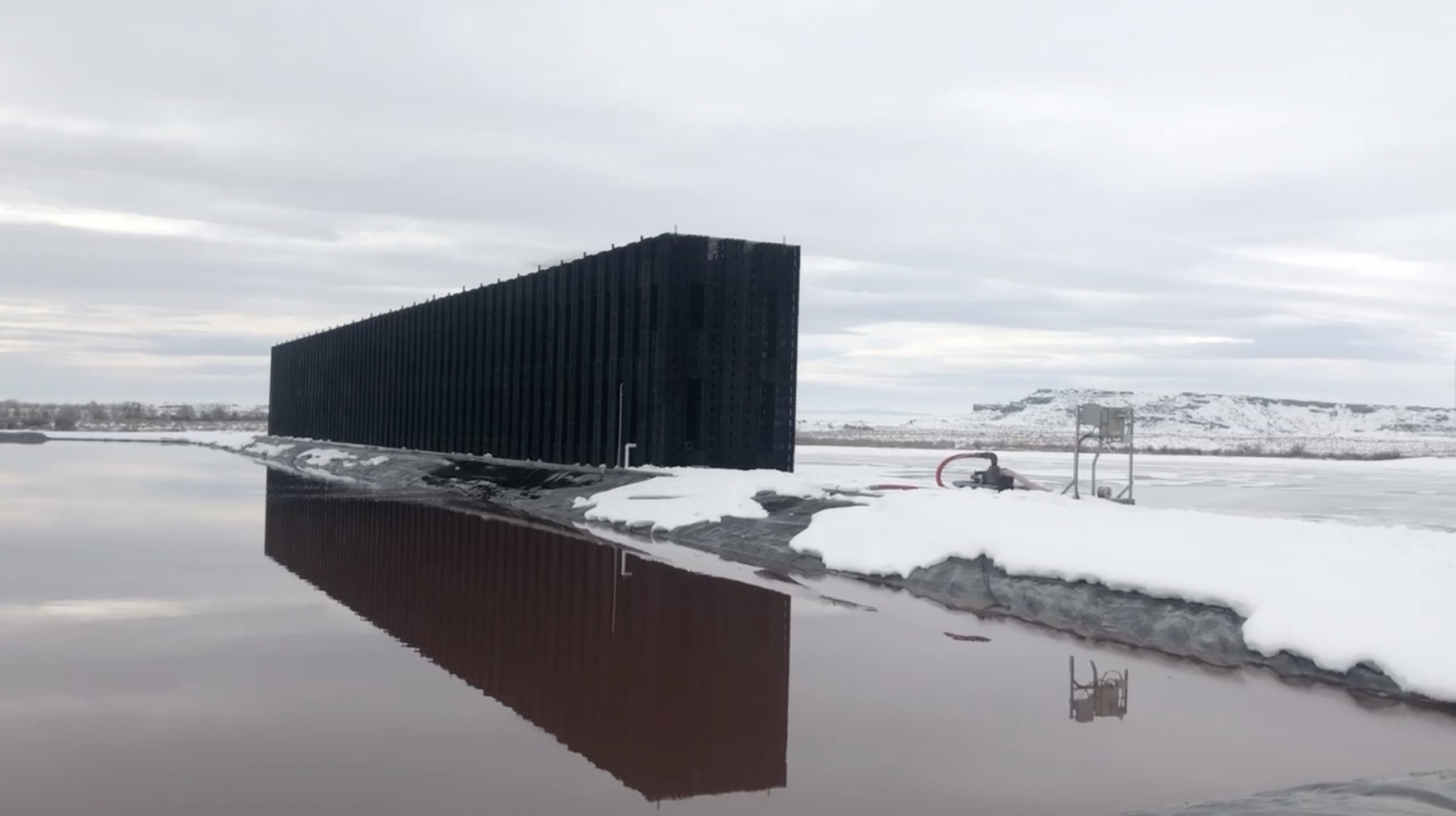
Passive wastewater evaporation for mountain sites and subzero operations
Most operators in cold climates assume the winter problem is about evaporation slowing down, but that’s only half the challenge. The deeper issue is what happens to a conventional evaporation pond over the course of a long winter. Ponds don’t just stop evaporating; they keep collecting. Every snowfall, rainstorm and period of snowmelt adds to the disposal volume while operators wait for conditions to improve. The hard reality is that by spring, you’re not managing the same water you had in fall. You’re managing that water plus months of accumulated precipitation.
For sites in Saskatchewan, Wyoming, Montana and similar cold-weather regions, this compounding effect made an already difficult situation worse. Disposal options were limited. Storage capacity was finite. And the water balance moved in the wrong direction all winter. Conventional spray-based systems offered no relief.
Sprayers iced over.
Misters turned into snowmakers.
Performance collapsed right when storage pressure was highest.
Our clients in these environments needed a winter-resilient system that actively reduces volume whenever conditions allow and stops adding to the problem when they don’t. That’s why they choose the Ecovap Matrix™.
How Ecovap impacts wastewater management in the winter
The Ecovap Matrix requires 95% less surface area than a comparable evaporation pond. That footprint difference is the foundation of its cold-climate advantage: less surface area means dramatically less precipitation and snowmelt collected over winter. Instead of forcing evaporation through pressure, misting or mechanical systems, Ecovap uses passive airflow and solar-driven evaporation to reduce volume whenever conditions allow.
And when winter temporarily slows evaporation, operators shift strategy: storage handles peak accumulation, then the matrix rapidly eliminates stored volume as temperatures rise and evaporation conditions improve.
Several operating conditions also help maintain performance in colder regions.
Most produced water already contains high salt concentrations, thereby lowering its freezing point significantly below that of standard freshwater. As concentration increases during evaporation, freezing resistance increases with it.
The matrix itself also absorbs solar heat. Its black HDPE surfaces retain warmth while holding only a thin film of water across the evaporation surface, helping maintain evaporation potential whenever sunlight is available.
And because the system relies on periodic rewetting cycles rather than continuous spraying, operators can adjust the circulation frequency during colder periods to keep water moving through the matrix.
No frozen mist clouds, nozzle failures or seasonal system collapse
A pond is a net accumulator in cold climates. It collects more from winter precipitation and snowmelt than it evaporates during cold months, and problems grow while operators wait. But Ecovap is a net evaporator. Across the full annual cycle, even accounting for slower winter months, the system eliminates more water than it collects.
Compared to trucking, injection or new pond construction, Ecovap is the lowest-cost water elimination option available for cold-climate operations. No fuel costs, no haulage contracts, no pond liner expansions. Just a passive system that extends the productive season as far as possible and stops the problem from growing when it can’t.
The cold hard numbers
95%
pond footprint reduction
-9°F
successful in extreme winter
1:0
net gain, no annual accumulation
Need a water elimination strategy that works through the winter?
Let’s explore a solution together.